 Brief Your AI
How to Check Whether AI Is Telling the Truth
AI can sound completely right and still be wrong. A simple way to check the facts, examine the sources, and decide what you can trust.
What you’ll get
| The result | A five-minute checking habit, and a way to sort any AI answer into verified, uncertain and unsupported |
| Level | Level 1 (chat). Works with any AI assistant |
| Loop step you’ll practice | Check, in depth |
| Time | About 10 minutes to read, 5 minutes to try |
1. Can you trust an AI answer?
Imagine you ask an AI assistant: “Is the Great Wall of China visible from the Moon?” It answers confidently. It might mention that the Wall is thousands of kilometers long, bring up astronauts and satellites, even give you a link. It sounds convincing. But how do you know it’s true?
You could ask “Are you sure?” That doesn’t solve much: the AI might correct itself, or confidently repeat the same mistake. The real question isn’t whether the answer sounds confident. It’s whether reliable evidence supports it.
Think of AI as a bright intern who sometimes misremembers, and never says so. You wouldn’t forward an intern’s report to your boss without checking the key numbers. A wrong answer might cost you a few minutes, or it might shape a decision about your money, your work or your health.
You don’t need to become a professional fact-checker. You need a practical method for checking what matters. At Brief Your AI, we call it the Three Checks:
- Check the claim.
- Check the source.
- Check the conclusion.
If you’ve read How to Brief Your AI, this is the Check step of Brief → Collaborate → Check, in depth.
2. Why AI can sound right and be wrong
AI assistants are very good at fluent, natural language. They explain, summarize and answer in seconds. But fluent language isn’t proof of accuracy. Errors creep in three ways.
It can generate wrong information. AI sometimes produces statements that are false, misleading or unsupported: a wrong date, an invented research paper, a quote attributed to the wrong person. This is usually called an AI hallucination; the US National Institute of Standards and Technology (NIST) calls it confabulation. The answer can still sound perfectly reasonable.
It may not have the latest information. Some answers rely on what the model learned in training. Without access to current information, it won’t know about recent changes. Even when it can search the web, it can misread a source or miss an update. That matters for prices, rules, product specs and news.
It can misunderstand real evidence. Sometimes nothing is invented: the AI finds a real report and reads it wrong. It confuses correlation with causation, drops an important limitation, or turns a narrow finding into a broad claim. This is harder to spot, precisely because the source is real.
These aren’t rare edge cases. One study checked AI search answers sentence by sentence and found that roughly 25% to 47% of statements weren’t supported by the sources the tools themselves cited (DeepTRACE, Salesforce AI Research, 2025). Another found that 3% to 13% of the links given by AI research tools probably never existed (arXiv 2604.03173, 2026).
A professional-looking answer isn’t necessarily a reliable one. And a citation isn’t automatically proof.
The Three Checks at a glance
When an AI answer matters, ask three questions:
| Check | The question | What you look for |
|---|---|---|
| 1. The claim | What exactly is being claimed? | Numbers, dates, names, quotes, comparisons, and words like always, never, only, proven |
| 2. The source | Where is the evidence? | Who published it, when, and whether it actually says what the AI says |
| 3. The conclusion | Does the conclusion follow? | Limitations ignored, assumptions added, a finding applied to the wrong situation |
Let’s apply them to one example.
3. Check the claim: what is the AI actually saying?
Take this well-known statement:
The Great Wall of China is the only human-made structure visible from the Moon with the naked eye.
It sounds believable: the Wall is enormous. But before looking for evidence, read the wording closely. It’s really three claims: the Wall is visible from the Moon; it can be seen with the naked eye; and it’s the only human-made structure that can. A photo of the Wall taken “from space” wouldn’t prove all three, because space isn’t the Moon, and a camera lens isn’t the naked eye. And “only” is a claim of its own.
The same thing happens with everyday AI answers. Suppose it tells you: “Remote work always makes employees more productive.” The word always should make you curious. Does the evidence cover every job, every person, every workplace? Probably not. A more careful version would say remote work can improve productivity in some situations, depending on the work and how productivity is measured, and even that needs evidence.
Before you check whether an answer is true, make sure you know exactly what it claims.
4. Check the source: find the original evidence
For the Great Wall, good sources are easy to find. NASA has addressed the question directly, and Scientific American summarizes what astronauts have reported. From the Moon, Neil Armstrong described seeing continents, lakes and oceans, but no human structures. From low Earth orbit, the Wall is hard to spot with the naked eye; China’s first astronaut, Yang Liwei, said he didn’t see it. Yet a 2004 photo taken from the International Space Station appears to show part of it (Scientific American; NASA).
These facts don’t contradict each other. They describe different distances and different ways of looking.
Four questions for any source
- Does it exist? AI can produce references that look real and lead nowhere. Open the link.
- Who published it? Look for the original organization, author or institution. For a government rule, the government agency beats an anonymous blog. Authority depends on the question: a medical body for clinical guidance, the manufacturer’s documentation for a product spec.
- Is it current enough? A decades-old NASA explanation of what astronauts saw is still relevant. An old article about tax rules or software prices probably isn’t.
- Does it actually support the claim? The most important one. Suppose an AI writes “Research proves that working from home increases productivity by 30%” and links a genuine paper (this is a made-up example). You open it and find it studied one group of workers under specific conditions. The paper is real; the broad conclusion is misleading. Read the relevant passage, not just the link.
Look for independent confirmation
For important, surprising or disputed claims, find another reliable source that addresses the same question independently. Careful: five websites repeating the same original story aren’t five confirmations. Trace the claim back to the original research, official record or firsthand evidence.
This is the idea behind SIFT, a method created by researcher Mike Caulfield: Stop before you react or share, Investigate the source, Find better coverage, and Trace claims to their original context (Writing Commons).
A citation is where checking starts, not where it ends.
5. Check the conclusion: does the evidence really support it?
Back to the Great Wall. The original statement is false. But be careful not to swap one misleading statement for another: “The Great Wall can never be photographed from space” would be wrong too. The evidence supports something more precise:
The Great Wall can’t be seen with the naked eye from the Moon, although parts of it appear to have been photographed from low Earth orbit.
That sentence keeps every distinction that matters.
Three common reasoning mistakes
| Mistake | What happens | Example |
|---|---|---|
| Possibility becomes certainty | A source says something may happen; the AI says it will | A forecast turned into a fact |
| A finding applied too broadly | One group, one setting, presented as a universal rule | A study of call-center staff summarized as “workers” |
| Conditions left out | The facts are right, but they don’t apply to you | A rule for companies above a certain size presented as applying to everyone |
Checking individual facts isn’t always enough. Also ask whether the AI drew a reasonable conclusion from them.
6. Three work examples
The Great Wall is a fun warm-up. Checking really pays off at work. These three situations are illustrative teaching examples, not transcripts of real AI errors.
Example 1: A tool your team uses “changed its pricing”
An AI summary says: “The project tool your team uses raised its prices last week.” Before you forward it to your manager:
- Claim: Which plan? Which price? Since when? For new customers or everyone?
- Source: Look for the company’s own pricing page or official announcement, with a date. Be wary of articles about rumored or “expected” changes.
- Conclusion: Does it affect your team’s plan and contract, or only new sign-ups?
What you learned: current information needs current evidence. Always check the date and what actually changed.
Example 2: “AI makes people 40% more productive”
You’re writing a proposal and AI offers this statistic. It sounds great for your argument.
- Claim: Productivity at what? Which tasks, which people, compared with what?
- Source: Find the original study. Look at who took part, what was measured (speed, quality, or both), and the stated limitations.
- Conclusion: A 40% gain on one specific task doesn’t mean everyone becomes 40% more productive. Quote the finding with its conditions, or don’t use it.
What you learned: a real statistic becomes misleading when its context is stripped away.
Example 3: “Do we need a data protection officer?”
You run a small team in the EU and ask AI whether GDPR requires you to appoint a Data Protection Officer. It says yes and gives you a to-do list.
- Claim: Which rule exactly, for which kind of organization?
- Source: Go to the official legal text or your national data protection authority. Under GDPR, the requirement depends on conditions, such as what kind of data you handle and on what scale.
- Conclusion: Does the rule actually apply to your situation? Is everything on the list a legal requirement, or general good-practice advice the AI added?
If the consequences are significant, get qualified professional advice.
What you learned: a correct general explanation can still lead to the wrong decision when your specific circumstances are missing.
7. Your five-minute checking habit
You don’t need to investigate every sentence. Brainstormed ideas or a friendlier email rarely need fact-checking. But when an answer contains important facts, numbers, sources or recommendations, take five minutes:
| Time | What you do |
|---|---|
| Minute 1 | Spot the claims that matter: dates, numbers, quotes, anything your decision depends on |
| Minutes 2–3 | Find the evidence: open the sources; if there are none, search for the original yourself. Prefer primary sources: official documentation, research papers, government publications |
| Minute 4 | Compare: does the source really say that? Look for missing conditions, different numbers, outdated information |
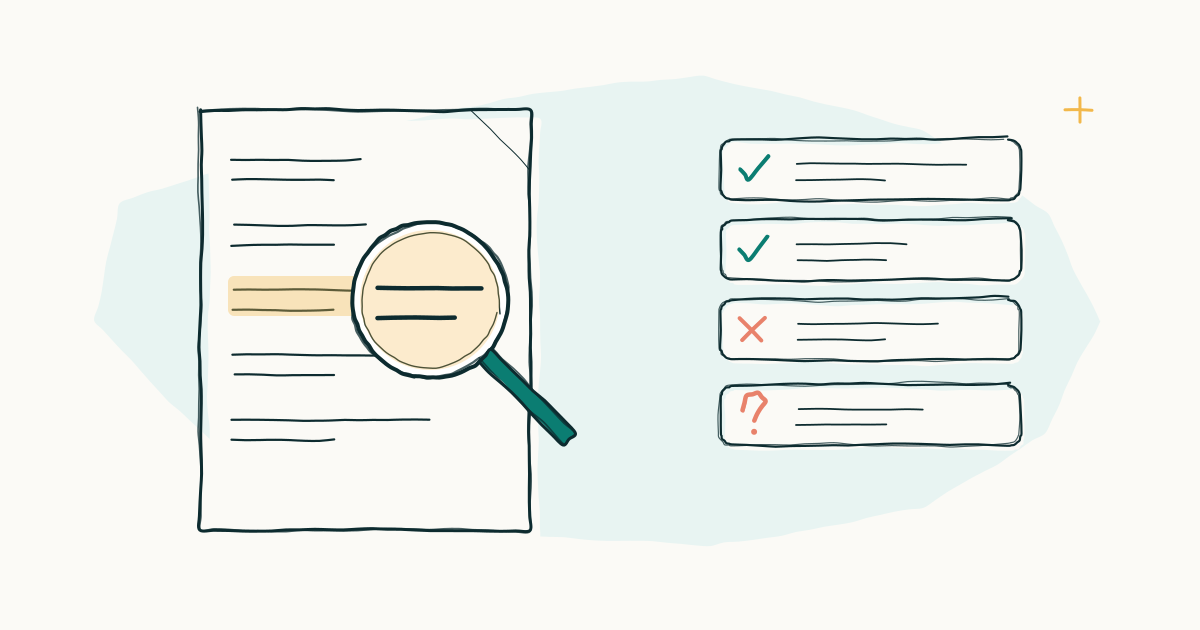
| Minute 5 | Sort the answer into verified, uncertain, and unsupported or wrong |
- Verified: supported by suitable evidence.
- Uncertain: some evidence, but important questions remain.
- Unsupported or wrong: evidence missing, contradictory, or not saying what the AI claimed.
If you can’t verify something, don’t present it as fact. Five minutes is a starting habit, not a guarantee: complex or high-stakes questions may need more research or an expert.
A prompt to help you start
You can ask the AI to lay out what needs checking:
Review your previous answer.
List the three most important factual claims.
For each claim, give the source, explain what the source actually supports, and note any uncertainty.
If you can't verify a claim, label it "unverified". Do not invent citations.
This shows you where to focus. But asking AI to check itself isn’t independent verification. You still need to open the sources. For important claims, also ask a different AI tool the same question and compare: if they disagree, treat the claim as uncertain. Research Anything with AI walks through this cross-check step by step.
Checklist
Before you use or share an AI answer that matters:
- I know exactly what each key claim says, including words like always and only
- I opened the sources, and they really say what the AI claims
- The information is current enough for my question
- The conclusion doesn’t go further than the evidence
- Anything I couldn’t verify is labeled as uncertain
The one thing to remember
AI can be a great research assistant, writing partner and tutor. It shouldn’t be your final authority on facts that matter. A confident tone doesn’t prove accuracy. A link doesn’t automatically prove a claim. And a true fact doesn’t always support the conclusion drawn from it.
You don’t need to distrust everything your intern says. You need to know how to check what matters.
Check the claim. Check the source. Check the conclusion.
Don’t ask whether AI sounds right. Ask whether the evidence supports it.
Further reading
The Three Checks is a teaching framework developed for Brief Your AI. Its principles are consistent with guidance from AI providers, information-literacy educators and standards bodies.
- OpenAI: Does ChatGPT tell the truth?
- Anthropic: Reduce hallucinations
- NIST: Generative AI Profile (AI 600-1)
- Scientific American: Is China’s Great Wall visible from space?
- NASA: China’s Wall Less Great in View from Space (PDF)
- SIFT: Stop, Investigate, Find, Trace (Writing Commons)
- DeepTRACE study on AI search answers (Earth.com, 2025)
- Study on hallucinated citation links (arXiv, 2026)
Next
Put the Three Checks to work: try Research Anything with AI (free), or go back to How to Brief Your AI to get better answers in the first place.
Get new tutorials by email
One email when a new tutorial is out. No spam, unsubscribe any time.
Almost done: check your inbox and click the link in the email to confirm.
That didn't work. Check the address and try again.
I only use your address to send new tutorials. Privacy